Showing posts with label speech function. Show all posts

Friday, 4 December 2020

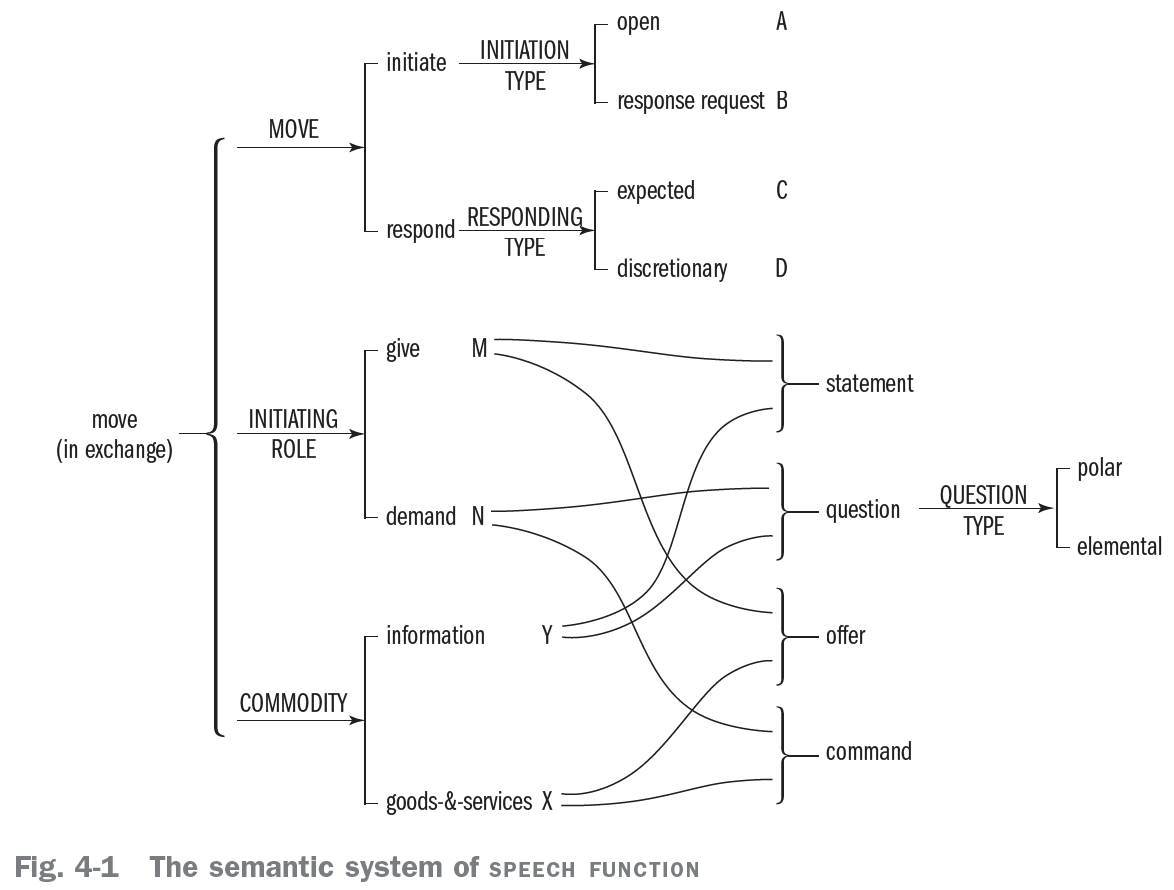
Misrepresenting Halliday's Semantic System Of Speech Function As Martin's Discourse Semantic System

Martin & Rose (2007: 251, 252):
As far as the realisation of SPEECH FUNCTION in MOOD is concerned, we noted the important role played by indirect speech acts (Halliday’s mood metaphors) as far as expanding the meaning potential available for speakers to negotiate within dialogue. The major MOOD options for the English clause are outlined in Figure 7.5. Technically speaking, speech function is a discourse semantic system realised through the grammar of mood (including vocation, tagging, modality and polarity which are not included in Figure 7.5).


Blogger Comments:

[1] Cf Halliday & Matthiessen (2014: 162):


[2] This is misleading, because it misrepresents Halliday's semantic system of speech function as Martin's discourse semantic system. As previously noted, the authors have not acknowledged Halliday as the intellectual source of the system of speech function, anywhere in this chapter.

Tuesday, 1 December 2020

The Authors' System Of Speech Function

Martin & Rose (2007: 251, 252):
In this chapter we’ve developed two systems for analysing dialogue. The first, SPEECH FUNCTION, was designed to explore the relationship between moves and their realisation in grammar (technically speaking their MOOD). The relevant network of choices is consolidated in Figure 7.4, and allows for the 13 basic speech acts presented above. Further delicacy is of course possible; we could for example distinguish questions asking for missing content from those exploring the modality and polarity of a given clause (i.e. Who betrayed Daniel? vs Did one of his friends betray Daniel?). This kind of specificity is much further developed in Eggins and Slade (1997) and in the work of Hasan and her colleagues (e.g. Hasan 1996).

Blogger Comments:

[1] This is misleading, because, once again, the authors' here misrepresent themselves as the intellectual sources of Halliday's system of SPEECH FUNCTION. See, for example, Halliday (1985: 68-71).

[2] To be clear, the network in Figure 7.4

  • has no entry condition, 
  • omits the minor speech function 'alarm' ('warning' vs 'appeal')
  • ungroups minor speech functions ('express self' vs 'attending'), and
  • groups minor speech functions with major speech functions ('attending' with 'negotiating').
Cf Halliday & Matthiessen (2014: 136):

Sunday, 22 November 2020

The Problem With The Obligatory/Optional Move Distinction

Martin & Rose (2007: 239-40):
To complete the picture we can now allow for the possibility of follow-up moves by the secondary actor or knower (with 'f' standing for ‘follow up’):
And if they do follow up, then there is the possibility of a further follow-up move by the primary actor or knower:
We can sum up the various possibilities reviewed here using parentheses for optional moves. The structure potential for action exchanges is thus:
((dA1) ^ A2) ^ A1 ^ (A2f ^ (A2f))
And for information exchanges, we find the same possibilities:
((dK1) ^ K2) ^ K1 ^ (K2f ^ (K2f))


Blogger Comments:

[1] To be clear, on this model, the only obligatory move in the exchange between the waitress and Hendrik is said to be her A1 move Yes. All the other moves, including her offer Wine? and his metaphorical command Could I have a bottle of your best dry red? — which elicits her "obligatory" move — are mere optional extras.

Similarly, the only obligatory move in the exchange between Sannie and Llewelyn is said to be her K1 move Coetzee. All other moves, including her metaphorical command You'll never guess who's here and his question Who? — which elicits her "obligatory" move — are mere optional extras.

[2] Logically, these should read (dA1 ^) and (dK1 ^), not (dA1) ^ and (dK1) ^.

[3] Logically, these should read (^ A1f) and (^ K1f), not ^ (A2f) and ^ (K2f).

Friday, 20 November 2020

Problems With Analyses Using Anticipatory Moves (dA1 & dK1)

Martin & Rose (2007: 238):
A third possibility is for exchanges to be initiated by primary actors and knowers who anticipate proffering goods or performing a service by offering first to do so, or anticipate professing information by first alerting their addressee that it is coming. These anticipatory moves in a sense delay the exchange of goods-and-services and information, and so are referred to by Berry as dA1 and dK1 moves (with ‘d’ standing for ‘delay’):
These dK1^K2^K1 sequences can be used in conversation to re-affirm a proposition that needs to be foregrounded, for example as part of an argument amongst Daniel’s comrades about who betrayed him to the authorities.


Blogger Comments:

[1] To be clear, in terms of SFL Theory, the exchange between the waitress and Hendrik involves two speech functions, offer and command, with the response to the offer ellipsed. A more congruent rendering of the exchange would be:

  • Can I get you some wine? (Offer)
  • Yes. (response: acceptance)
  • Please bring a bottle of your best dry red. (Command)
  • I will. (response: undertaking)

Similarly, the exchange between Sannie and Llewelyn also involves two speech functions, command and question, with the response to the command ellipsed. A more congruent rendering of the exchange would be:

  • Guess who's here. (Command)
  • Okay. (response: undertaking)
  • Who's here? (Question)
  • Coetzee is here. (response: answer)

Importantly, contrary to the authors' analysis, with the metaphor unpacked, the first move involves goods-&-services ('A'), not information ('K').

See Halliday & Matthiessen (2014: 137).

[2] To be clear, the exchange between Luke and Zako involves a rhetorical question: a question asked in order to create a dramatic effect or to make a point rather than to get an answer.

Tuesday, 17 November 2020

Problems With Obligatory Moves And With Primary vs Secondary Actor/Knowers

Martin & Rose (2007: 237-8):
We can interpret what is going on here as follows, drawing on work by Ventola (1987), who was in turn building on work by Berry (e.g. 1981). Minimally speaking, exchanges consist of one obligatory move. When negotiating goods-and-services, this is the move that proffers the goods or performs the service; when negotiating information, this is the move that authoritatively establishes the facts of the matter.
Berry refers to goods-and-services negotiations as action exchanges, and information exchanges as knowledge ones. And she refers to the person responsible for proffering goods or performing a service as the primary actor, and the person who has the authority to adjudicate information as the primary knower. On this basis, the waitress’s move below is nuclear A1 move, and Sannie’s is Kl:
Berry refers to the dialogue partner for primary actors as a secondary actor, who is the person who receives the goods or has the service performed for them; the secondary knower is the person who receives the information professed by the primary knower. Where exchanges are initiated by the secondary actor (requesting goods-and-services) or the secondary knower (requesting information), we find canonical two-part exchanges like the following:


Blogger Comments:

[1] To be clear, in the exchange of goods-&-services, the move that "proffers the goods" or "performs the service" is not the obligatory move, since these can be omitted in an exchange. These moves are responses to commands or offers, and responses are not obligatory. If there is an obligatory move in an exchange, it is the move that brings it into being, the initiating move.

[2] To be clear, this confuses semantics with context. Relations between interlocutors — primary vs secondary actor or knower — are a matter of tenor, the interpersonal dimension of context, the culture as a semiotic system. The moves they enact in an exchange are units in the interpersonal dimension of semantics, the language as a semiotic system.

Sunday, 15 November 2020

Misrepresenting Halliday's Approach To 'Calls' As The Authors' Insight

Martin & Rose (2007: 235): 
As a rule of thumb we can include expletives and vocatives in other moves where possible, and treat them as independent moves only when there is nothing to append them to. So Sannie would be a vocative in the following command by her father:
Hendrik: Sannie, go with Father Dalton.
Sannie: - (goes)
But in the movie version of this exchange, Coetzee has been attacked and injured by Ernest, and in the ensuing chaos Hendrik has to first get Sannie’s attention before negotiating his demand for service:
Hendrik: Sannie.
Sannie: - What?
Hendrik: Go with Father Dalton.
Sannie: - (goes)

Blogger Comments:

This is misleading. Yet again, Martin & Rose misrepresent Halliday's theorising as their own. Halliday (1994: 95):

Tuesday, 10 November 2020

Confusing Modal Responsibility With Moral Responsibility

Martin & Rose (2007: 234-5):
Technically speaking, what we are saying is that a move is a ranking clause, including any clauses embedded in it, and in addition any clauses dependent on it. So we can tag the main clauses in the examples below; they are negotiable. Coetzee makes others responsible for the torture facility, not his role in it:
And Sannie makes the village gossipmongers responsible, not her family:
The underlined clauses are not directly negotiable; to make them so would require an additional initiating move in which they are promoted from a subordinate to an arguable position.


Blogger Comments:

[1] This is misleading. Once again, Martin & Rose are misrepresenting Halliday's model of speech function as their own theoretical creation.

[2] To be clear, this confuses moral responsibility (for the torture facility) with modal responsibility (whether or not it is valid to state they had a facility outside Capetown…). 

[3] To be clear, the modal responsibility here is for the validity of the claim they'll say we're selling the house.

[4] To be clear, the projected clause we're selling the house can be challenged in a response move, as exemplified by But we're not (selling the house). Moreover, not only is this possible, it is more likely than a challenge to the projecting clause: But they won't say that.

In short, on the authors' model, the move But we're not (selling the house) would not be analysed as a responding move to they'll say we're selling the house, but would instead be analysed as a new initiating move.

Sunday, 8 November 2020

The Authors' Definition Of A Response

Martin & Rose (2007: 232-3):
We can thus define a response as a move which:
(1) takes as given the experiential content of its initiating pair part
and
(2) accepts the general terms of its argument established by its Subject-Finite structure (i.e. its polarity/modality/temporality). …
But a response does not allow for changes to the nub of the argument (its Subject),  or to the content of what is being argued about in the rest of the clause. By definition, any move making changes of this kind would not be considered a response but a new initiating move.

Blogger Comments:

[1] To be clear, speech function is concerned with interpersonal meaning, not with experiential meaning. In the case of propositions, what is accepted or rejected in a response is the validity of what is predicated of the Subject (Halliday & Matthiessen 2014: 148, 151-2).

[2] To be clear, a responding move may accept or reject the validity of a proposition or proposal. 

[3] Halliday & Matthiessen (2014: 148):

From above, [the Subject] is that which carries the modal responsibility: that is, responsibility for the validity of what is being predicated (stated, questioned, commanded or offered) in the clause. … The notion of validity relates to the arguing of the case, if it is a proposition, or to the putting into effect if it is a proposal. The Subject is that element in which the particular kind of validity (according to the mood) is being invested.

Friday, 6 November 2020

Misrepresenting Halliday's Speech Function As The Authors' Creation

Martin & Rose (2007: 227):
In the previous section we proposed an inventory of 13 basic speech acts; we now need to think about how to distinguish them from one another when analysing conversation. One useful set of markers includes please, kindly, ta, thanks, thankyou, OK, alright, no worries, you're welcome, not a problem, which normally indicate moves concerning goods-and-services. Here Ernest pleads with Coetzee to stay and talk to his parents (until the comrades can get there to kill him):
And Hendrick orders wine for dinner with Coetzee and his family:
Where such markers are not present, we can check to see if they could have been (adding for example please to Hendrik’s command and alright to verbalise Sannie’s response to her father below):

Blogger Comments:

[1] This is misleading. Once again Martin & Rose are misrepresenting Halliday's major and minor speech functions (minus 'alarms') as their own creation.

[2] To be clear, the SFL way to identify speech functions in a text is to take the view 'from above' (the meaning being realised). This means using the semantic system of which they are instances. For example, in the case of major speech functions (realised by major clauses):
  • if information is given, then it is a statement;
  • if information is demanded, then it is a question;
  • if goods-&-services are given, then it is an offer;
  • if goods-&-services are demanded, then it is a command.

[3] To be clear, contrary to SFL Theory, here Martin & Rose advocate taking the view 'from below' (how meaning is realised) instead of the view 'from above' (the meaning being realised).

Tuesday, 3 November 2020

Misunderstanding Halliday's Moodtags And Misrepresenting Them As The Authors' Work

Martin & Rose (2007: 226):
Moves may also end with tag 'questions' (don’t you?, isn't he?, etc.) oriented to the addressee. These tags do not function as separate moves, but are better treated as explicit invitations to a listener to respond. Both of Sannie’s speech acts below would thus be treated as tagged statements (not as statements followed by questions). There is after all only one proposition being negotiated, not two:


 Blogger Comments:

[1] This is misleading. Yet again, Martin & Rose here present Halliday's work as if it were their own. Importantly, the tag doesn't just invite a response; it signals the type of response expected. Halliday (1985:69):


[2] This is misleading. While the first instance is a tagged declarative clause realising a statement, the second instance does not feature a Moodtag, and realises two speech functions, not one. To explain:

Firstly, a Moodtag reprises the Finite and Subject of a clause, so the (unmarked) Moodtag for you could have killed the man is couldn't you? not you know.

Secondly, there are two propositions
  • the projected statementyou could have killed the man, and
  • the projecting question: you know (realised metaphorically as a declarative clause),
each of which could be challenged in response.

Moreover, the projecting clause you know can itself be tagged by don't you?, further demonstrating that it is not a Moodtag but a proposition in its own right.

Sunday, 1 November 2020

Vocatives

Martin & Rose (2007: 225-6):
Moves may contain names which specify who is expected to respond (vocatives). For analysis purposes we recommend not treating vocatives as distinct moves when they simply accompany a speech act, addressing its receiver. This would mean treating Ernest’s move addressing Coetzee below as a statement including the vocative you white piece of shit, and his father’s move as a command including the vocative Ernest:
So vocatives are only taken as separate speech acts when they function as a move on their own, in greeting or calling sequences, as illustrated above… .


Blogger Comments:

[1] This is misleading, because this is simply the analysis that is consistent with SFL Theory, and yet Martin & Rose present it as their recommendation.

[2] To be clear, unknown to Martin & Rose, this an instance of interpersonal metaphor: a command realised by a declarative clause with Mood ellipsis:


[3] Trivially, these are moves in exchanges, not sequences. Sequences (of figures) are ideational, not interpersonal.

Friday, 30 October 2020

Problems With The Authors' Speech Function System

 Martin & Rose (2007: 225, 226):

This account gives us a speech function system comprising the basic options displayed in Figure 7.1.


Blogger Comments:

The most obvious problems with the authors' network are as follows:
  1. There is no entry condition;
  2. The minor speech functions are split ('express self' vs 'attending'), with the latter grouped with major speech functions ('negotiating');
  3. The minor speech function 'alarm' is not accounted for;
  4. The INITIATING ROLE system ('giving' vs 'demanding') is not named;
  5. The COMMODITY system ('information' vs 'goods-&-services') is not named; but most importantly,
  6. The INITIATING ROLE system ('giving' vs 'demanding') appears six times instead of once.
A competently organised network is provided by Halliday & Matthiessen (2014: 136):

Tuesday, 27 October 2020

Misrepresenting Halliday's Minor Speech Functions As The Authors' Ideas

Martin & Rose (2007: 224, 225):
Minimally, we need five more speech acts to complete the picture. Two are concerned with greeting and leave-taking (the hellos and good-byes framing conversations as people come and go, phone up and sign off). We can refer to these as greeting and response to greeting moves. …
Then there is the question of getting people’s attention once they are there - call and response to call. …
Finally we need to consider outbursts of appraisal, such as Helena’s Dammit! in the interpretation stage of her exemplum. … As explosions of personal affect, exclamations are not really negotiable — so we very seldom need to recognise a responding move.


Blogger Comments:

This is misleading, because here Martin & Rose misrepresent Halliday's minor speech functions as their own theorising. Halliday (1994: 95-6):

As can be seen from the above, Martin & Rose fail to include Halliday's minor speech function 'alarm' and its two sub-types: 'warning' and 'appeal'.

Sunday, 25 October 2020

Misrepresenting Halliday's SPEECH FUNCTION As The Authors' System

Martin & Rose (2007: 224):
These three oppositions are summarised and exemplified in Table 7.2. They give rise to eight speech acts, which form the heart of the discourse semantic system we’ll refer to as SPEECH FUNCTION.

Blogger Comments:

Here Martin & Rose go beyond not acknowledging Halliday as the source of "their" ideas to actually presenting Halliday's SPEECH FUNCTION as their idea. Cf Halliday (1985: 69):

Friday, 23 October 2020

Misrepresenting Halliday's 'Role In Exchange' As The Authors' Ideas

Martin & Rose (2007: 223-4):
The third parameter to consider is that of giving vs demanding. This opposes statements to questions as far as information is concerned, and offers to commands for goods-and-services:


Blogger Comments:

Here again there is no acknowledgement that this is Halliday's theorising, and the trusting reader is left with the impression that this is the work of Martin & Rose. Cf Halliday (1985: 69):

Tuesday, 20 October 2020

Misrepresenting Halliday's Ideas As The Authors' Ideas

Martin & Rose (2007: 223):
Based on the examples introduced above we can extract three basic parameters of negotiation — what it is we are negotiating, whether we are giving or demanding it, and whether a move initiates the exchange or responds. First, there is the question of what we are negotiating — information or goods-and-services. Note, as illustrated below, that when negotiating information we expect a verbal response (or gesture), whereas when negotiating goods-and-services we expect action.
These examples also illustrate a second parameter — the complementarity of initiating and responding moves in dialogue. Compliant responding moves may be quite elliptical, since the content being negotiated is easily recovered from the initiating move; and with goods-and-services transactions, language is in any case an optional accompaniment to behaviour (unless we are promising future action).


Blogger Comments:

Here Martin & Rose continue to present Halliday's ideas as if they were their own. Cf Halliday (1985: 68-9):

Sunday, 18 October 2020

Misrepresenting Halliday's SPEECH FUNCTION As The Authors' Model

Martin & Rose (2007: 222-3):
We’ll begin with our model of kinds of moves, focusing initially on statements, questions, offers and commands and compliant responses to them, as set out in Table 7.1.

Blogger Comments:

This is very misleading indeed. As well as failing to acknowledge Halliday as the intellectual source of the system of SPEECH FUNCTION, Martin & Rose here explicitly misrepresent it as their own model. Cf Halliday (1985: 69):

Tuesday, 28 May 2019

Mistaking Range For Medium And Medium For Agent

Martin & Rose (2007: 92):
Amnesty is construed here as a commodity that is given or refused to various recipients, by an implicit giver (the Commission), and is also demanded by potential recipients (police officers). The central elements in this construal are the processes of exchanging (given, not given, refused, applied for), the nuclear element is the commodity exchanged (amnesty), and the marginal elements are its givers and recipients. We can represent these nuclear relations in Figure 3.10.
 
Blogger Comments:

[1] Here Martin & Rose use the terms of speech function (enacting interpersonal meaning) — exchanging (giving or demanding) commodities (goods–&–services or information) — as the basis for determining the relative involvement of participants in a process, in their rebranding of Halliday's ergative model of transitivity (construing experiential meaning) as a discourse semantic system. The confusion is thus one of metafunction.

[2] To be clear, Martin & Rose provide no argument as to why processes are central, why the commodity (Range misinterpreted as Medium) is nuclear, or why givers (Medium misinterpreted as Agent) and recipients (Beneficiaries) are marginal.  This confirms that Martin & Rose do not understand the ergative principle on which Halliday's model of clause nuclearity is based.

[3] To be clear, Martin & Rose misinterpret the ergative functions of these clauses, mistaking Range for Medium and Medium for Agent:

the Commission
may grant
amnesty
to those who plead guilty
Medium
Process
Range
Beneficiary

the Commission
does not give
amnesty
to innocent people
Medium
Process
Range
Beneficiary

the Commission
does not give
amnesty
to those who claim to be innocent
Medium
Process
Range
Beneficiary

the Commission
refused
amnesty
to the police officers
Medium
Process
Range
Beneficiary

the police officers
applied for
amnesty
Medium
Process
Range

That is, it is through the Commission and the police officers that the processes of 'granting' etc. are actualised, with amnesty as the domain of such processes.

These errors invalidate the model in Figure 3.10, even in its own terms.  In Halliday's original model, the Commission and the police officers are nuclear, with amnesty outside the nucleus:


[4] To be clear, Martin & Rose construe nuclear relations
  • as lexical (and discourse semantic), even though the relations obtain between elements of grammatical structure, and
  • as nuclear, even though, in their understanding, it is not the nucleus to which other elements are related.

The bigger picture here is that Martin & Rose are taking Halliday's ergative model of clause grammar and rebranding it as part of Martin's model of discourse semantics.  Yet, in doing so, they demonstrate that they do not understand the principle on which Halliday's model is based, and that they cannot apply it accurately to data. 

Sunday, 10 December 2017

Misunderstanding Projection

Martin & Rose (2007: 50-1):
In Helena’s narrative, projection doesn’t just happen within sentences, from ‘saying' to ‘what is said'. It can also happen across whole texts and text phases. For example Helena begins by presenting herself as narrator (my story begins):
My story begins in my late teenage years as a farm girl in the Bethlehem district of Eastern Free State.
The rest of her story then is what she tells. And she closes her story by handing over to her second love (a few lines…):
I end with a few lines that my wasted vulture said to me one night
In both cases Helena’s sentence ‘projects’ the sentences that follow, just as the SABC ‘projected’ Helena’s story:
they broadcast substantial extracts
And Tutu in turn projects the SABC broadcast:
The South Africa Broadcasting Corporation's radio team covering the Truth and Reconciliation Commission received a letter from a woman calling herself Helena
So ultimately we have Tutu saying that the SABC said that Helena said that her second love said what he said. This is managed between sentences by naming ‘speech acts’, such as my story, a few lines, a letter, substantial extracts. This kind of projection between sentences is often associated with the beginning and end of texts.

Blogger Comments:

[1] This misconstrues the projection relation between the author and her text as a projection relation within the text projected by the author.

[2] This misunderstands projection, which is a relation between different orders of experience.  In the text, the opening sentence and "the rest of her story" are construed as the same order of experience.  That is, "what she tells" includes the opening sentence, not just "the rest of her story".

[3] This misconstrues an Actor (Agent) they as a Sayer (Medium), a material Process broadcast ('transmitted') as a verbal Process, and a Goal (Medium) substantial extracts as Verbiage (Range).

[4] This misconstrues the projection relation between the speaker and his text as a projection relation within the text projected by the speaker.

[5] The naming of "speech acts" (speech functions) metaphorically construes verbal processes as participants, and as such, does not construe projection relations between "sentences".

[6] This misconstrues the names of projected locutions (my storya few linesa lettersubstantial extracts) as the naming of "speech acts" (speech functions) — the latter being the naming of the processes that project locutions.  The confusion is thus between orders of experience.

[7] This unsupported claim is invalidated by the misunderstandings identified in [5] and [6].

Sunday, 25 June 2017

Rebranding Speech Function As Negotiation

Martin & Rose (2007: 21):
Negotiation
The key resources here are for exchanging roles as an interaction unfolds, for example by asking a question and answering it, or demanding a service and complying with the command. Here one speaker demands information with a question, and the other responds with a statement:
Sannie: Are you leaving?
Coetzee: - Of course I'm leaving.
Next a father demands a service with a command, and his son complies:
Hendrik: Ernest, get those snœk [a kind of fish],
Ernest: - (Ernest proceeds to do so.)


Blogger Comments:

Martin's discourse semantic system of negotiation is a rebranding of Halliday's semantic system of speech function.  Halliday & Matthiessen (2014: 135):
These two variables [speech rôle and commodity], when taken together, define the four primary speech functions of offer, command, statement and question. These, in turn, are matched by a set of desired responses: accepting an offer, carrying out a command, acknowledging a statement and answering a question.