Showing posts with label new. Show all posts

Tuesday, 18 May 2021

The Horizontal Textual Organisation Of Layout: Given/New

Martin & Rose (2007: 323, 328):

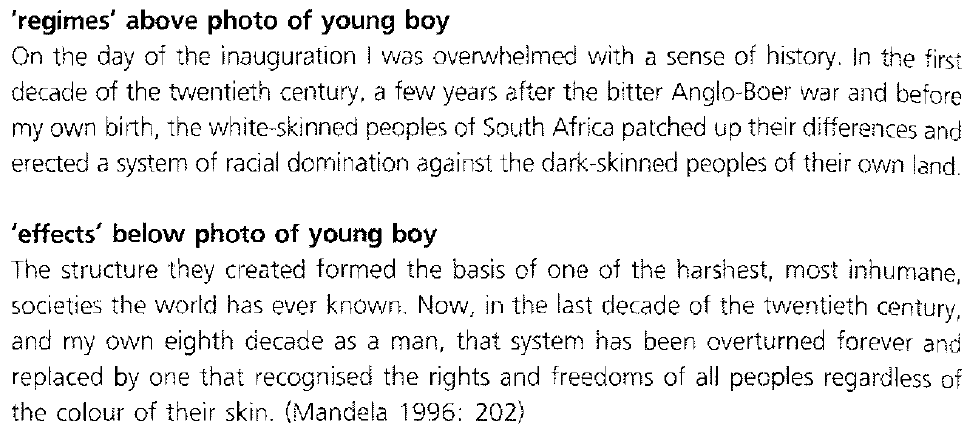
In the horizontal triptych on pages 202-3, the photo of the boy is Given and that of the inauguration is New.  The photos are more salient than the texts by virtue of their colour intensity and Given-New positions, with the inauguration image by far most salient. Our eye is attracted first to this large picture, then back to the photo of the boy, and then to the texts to explain the images for us. Within the left-hand vertical triptych, the image of the boy is more salient than the marginal texts above and below him, due to its size, colour and centrality. As a result we expect these texts to expand on the meaning of the photograph, and indeed they do, with enhancement.


Blogger Comments:

[1] To be clear, Martin & Rose provide no argument here for the applicability of Halliday's information unit to images and page layout. The authors merely accept its use by Kress & van Leeuwen (1996) without question. Moreover, there is no argument for treating the unmarked sequence, Given^New, as the only possible ordering. For information units, the structure may be:
  • Given^New
  • Given^New^Given
  • New^Given
  • New
Here the left image is claimed to be Given information merely because it is positioned to the left of the other image, which is claimed to be (the focus of) New information merely because it is positioned to the right of the other image. Martin & Rose provide no argument as to why a photograph of a boy in the crowd (who is not mentioned in the text) should be Given information relative to the photograph of the flag in the same crowd. It might be argued that the new South African flag is presented as New, but Martin & Rose do not make that argument.

[2] To be clear, here Martin & Rose have (unwittingly) switched their attention from the content plane to the expression plane, confusing salience of expression (size, colour, layout position) with salience of content.

[3] This is misleading, because it is untrue. While it is true that the photograph provides an instance of 'the dark-skinned peoples' mentioned in the texts, the texts above and below the photograph say nothing whatsoever about the meaning of the photograph:
See further in the following post. 

Friday, 9 October 2020

Packaging Discourse Through Explicit And Implicit "Scaffolding" And "Grammaticalising" Periodicity As Clause Complexing

Martin & Rose (2007: 215):
As we’ve seen, discourse gets packaged in various ways. Explicit scaffolding involves the erection of a hierarchy of periodicity beyond the clause, with layers of Theme and News telling us where we’re coming from and where we’re going to. With serial expansion there’s a change of gears from one discourse phase to the next, without any explicit scaffolding of the change. In some kinds of discourse, such as legislation, explicitness is in a sense pushed to its limits by (i) grammaticalising as much hierarchy as possible within very complex sentences and/or (ii) naming sections of the text numerically and/or alphabetically, and/or providing them with headings. Many texts involve some combination of all these resources for phasing information into digestible chunks.


Blogger Comments:

[1] As we've seen, the authors' 'hierarchy of periodicity' is writing pedagogy masquerading as linguistic theory; it does not apply to any texts that don't conform these proposals for how to write, or to any texts that are spoken or signed. Moreover, the model falsely assumes that New information is never thematic, and confuses textual status (Theme, New) with textual transitions made through (implicit) appositive and summative elaboration ("predicting" and "distilling").

[2] As we've seen, in terms of SFL Theory, the authors' 'serial expansion' is concerned with textual transitions made through (implicit) relations other than elaboration (extension or enhancement).

[3] As we've seen, Martin & Rose misrepresent grammaticalisation — a shift in function from lexical to grammatical — as a shift in function from the discourse semantic stratum to the grammatical stratum. To be clear, whatever has a discourse semantic function also has a grammatical function, since strata are levels of symbolic abstraction, so the notion of a function shifting from one stratum to another is nonsensical. Moreover, the authors' claim is that their 'hierarchy of periodicity' (textual semantics) and clause complexing (logical grammar) perform the same function (since the latter is said to replace the former in some texts).