Showing posts with label misleading. Show all posts

Friday, 4 June 2021

Perception Management

 Martin & Rose (2007: 332):

Our experience is that the most influential factor shaping the direction of research is what we are developing our linguistics for. For us, as participants in the Sydney School, the development of discourse semantics out of cohesion, the emergence of genre theory and appraisal analysis, and the current interest in intermodality, have all been very much tied up with our concern with redistributing the literacy resources of western culture to the peoples who have historically been subjugated by them. Our aim has never been to promote a particular ideology, but simply to offer what we know about these language resources, so that people could redeploy them as they choose. This remains a central concern of our work and a major application in educational contexts, that continues to grow internationally, as we illustrated with David’s South African lesson in Chapter 7. But as far as we can see these peoples, be they working class, indigenous minorities, or third world nations, will have increasingly limited opportunities for such redeployment given current projections for global warming. This creates a new and pressing agenda for socially responsible linguistics.

To this point in time we have been primarily concerned, like the authors we have studied in this book, with subverting what Halliday (1993) has called the 'lordism' of the Eurasian culture bloc.


Blogger Comments:

[1] To be clear, Martin & Rose have not taken the work of others, misunderstood it, and rebranded it as their own for personal gain, but for the noble cause of social justice. This means that any challenge to the theoretical validity of their work must be made by those opposed to social justice.

[2] To be clear, contrary to their stated aims, Martin & Rose do promote a particular ideology — or range of ideologies — despite being unable to define, let alone model, ideology, as previous posts on that subject have demonstrated. However, what can be said is that Martin's focus on heroism, and on "building (his own) community", as well as his contempt for scientists, and his coercing of students to use his misunderstandings of Halliday's theory, in preference to Halliday's theory, all suggest an ideology that is quite at odds with that presented in this and other publications. As Bertrand Russell, in his History Of Western Philosophy (pp 21-2), observed:
Throughout this long development, from 600 BC to the present day, philosophers have been divided into those who wished to tighten social bonds and those who wished to relax them.  With this difference, others have been associated.  The disciplinarians have advocated some system of dogma, either old or new, and have therefore been compelled to be, in greater or lesser degree, hostile to science, since their dogmas could not be proved empirically.  They have almost invariably taught that happiness is not the good, but that ‘nobility’ or ‘heroism’ is to be preferred.  They have had a sympathy with irrational parts of human nature, since they have felt reason to be inimical to social cohesion.  The libertarians, on the other hand, with the exception of the extreme anarchists, have tended to be scientific, utilitarian, rationalistic, hostile to violent passion, and enemies of all the more profound forms of religion.  This conflict existed in Greece before the rise of what we recognise as philosophy, and is already quite explicit in the earliest Greek thought.  In changing forms, it has persisted down to the present day, and no doubt will persist for many ages to come.
[3] To be clear, here Martin & Rose explicitly identify themselves with Nelson Mandela and Desmond Tutu. Previously (p62), they have only explicitly identified Martin with Mandela:
His communion with Mandela, at such a distance in so many respects …

By repeatedly bathing in the reflected glory of genuine activists for social justice, through the inclusion of their texts in his publications, Martin has successfully misrepresented himself as a fellow activist. For a reality check, see Jim Martin "Honouring" The Late Ruqaiya Hasan.

[4] This is misleading, because it is untrue. Halliday (1993) makes no mention of "the lordism of the Eurasian culture bloc". Rather, his term 'lordism' refers to the notion of the uniqueness of the human species as the lords of creation, as an evolved destructive feature of our daily language. Halliday (2003 [1993]: 225-6):

So what are the lessons here for us as applied (or "applying") linguists? I tried to suggest in the paper I gave at the World Congress two years ago that the concept of doing applied linguistics means, among other things, that one is involved in the semiotic history of the culture. The point I was making there was that our dominant grammars lock us in to a framework of beliefs that may at one time, when they first evolved in language, have been functional, and beneficial to survival, but that have now become inimical to survival and harshly dysfunctional: the motifs of bigger and better (all 'growth' is positively loaded), of the uniqueness of the human species as lords of creation, the passivity of inanimate nature, the unboundedness of natural resources like water and air, and so on. These are not features of technical languages; they are aspects of our most unconscious, deeply installed, everyday common-sense grammar; and they are now very destructive, at a time when we have to learn to break the rhythm of endless growth, to identify ourselves with other species as part of a living whole, and to recognise that our planet is not a repository of infinite wealth and abundance. And I see this as an applied linguistic concern: to draw attention to these features of our daily language, its growthism and its lordism; and perhaps even to explore the possibility of design, though this will be forbiddingly hard to make succeed.

Tuesday, 1 June 2021

Misleading Through Misrepresentations, Misunderstandings And A Logical Fallacy

Martin & Rose (2007: 331-2):
From our own vantage point, there have been some interesting shifts of focus in discourse analysis over the four decades of Jim’s involvement and two decades of David’s. In the 1970s, cohesion was the favoured episteme, as grammarians cast their gaze outwards beyond the clause. In the 1980s it was genre that came to the fore, fostered in important respects by work on literacy development in the Sydney School, English for Academic Purposes and New Rhetoric traditions (Hyon 1996). The 1990s saw the emergence of evaluation as a major theme, as analysts developed models of attitude in functional and corpus linguistics (Hunston and Thompson 2000, Martin and Macken-Horarik 2003). Currently we are in the midst of a surge of interest in multimodal discourse analysis, inspired by the ground-breaking work of Kress and van Leeuwen (1996/2006, 2001) on images. Looking ahead, we can probably expect an emerging rapprochement between qualitative and quantitative approaches to text analysis, depending on the kinds of technology that can be brought to bear in large-scale studies of many and longer texts. Just how this will tend to focus discourse analysis epistemes is harder to predict. Our own approach, in this book and beyond, contrasts strikingly with current trends, which for operational reasons (or worse) tend to elide discourse semantics in favour of word counts, collocations and colligations — as if texts where random sequences of words, phases or clauses. As analysis technologies develop, we need to ensure these trends do not become entrenched in the field in the long term.


Blogger Comments:

[1] To be clear, in SFL Theory, discourse analysis is the use of linguistic theory (potential) to analyse texts (instances of language).

[2] This is misleading. Four decades before the first edition of this book Jim Martin turned 13 years old. David Rose, on the other hand, completed his PhD — describing an Australian language — only 5 years before the first edition of this book.

[3] On the one hand this is misleading, and on the other hand, this misunderstands the term 'episteme'. Firstly, it is misleading because it falsely claims that discourse analysis was restricted to cohesive analysis, which is merely the non-structural component of the textual metafunction. Discourse analysis potentially involves all of theory, but crucially, it deploys the grammar. As Halliday (1985: xvii) made clear:
A discourse analysis that is not based on grammar is not an analysis at all, but simply a running commentary on a text… the exercise remains a private one in which one explanation is as good or as bad as another.
Secondly, the use of 'episteme' is inconsistent with its use in philosophy, whether by Plato or Foucault, the latter being the more likely source for Martin & Rose. For Foucault, 'épistémè' means the epistemological assumptions on which meaning-making is based, as exemplified by the SFL Theory assumption that meaning is immanent of semiotic systems, not transcendent of them.

More generally, 'episteme' means a principled system of understanding, such as a science, and it contrasts with 'techne', an applied practice. In talking of the practice of discourse analysis, Martin & Rose are concerned with techne, not episteme. However, Plato distinguishes 'episteme' from 'doxa', common belief or opinion. In tracing a history of "favoured epistemes", Martin & Rose are actually concerned with doxa (with regard to techne).

[4] This is misleading. Here Martin & Rose are presenting Martin's personal trajectory of interests as if they were the prevailing trends in the worldwide SFL community as a whole.

[5] This is misleading, because here Martin & Rose fallaciously argue for the value of their own approach, discourse semantics, by contrasting it with a straw man: non-existent Systemic Functional linguists who analyse texts as if they "random sequences of words, phases or clauses."

Firstly, as this blog and the review of Martin (1992) have demonstrated, Martin's model of discourse semantics is his misunderstandings of Halliday's speech function (interpersonal semantics) and Halliday & Hasan's cohesion (non-structural textual lexicogrammar), rebranded as his own systems, and as such, as Martin's theoretical insights.

Secondly, in SFL Theory, the quantitative approach is used to distinguish texts according to register. Texts differ by the frequencies of feature selection, across all systems of the content plane, and these frequencies instantiate the probabilities of feature selection by which registers of language differ. This is, of course, all lost on those who cannot distinguish registers of language from the cultural context of language, such as Martin & Rose.

Tuesday, 25 May 2021

Enhancing Image-Text Relations

 Martin & Rose (2007: 323, 328-9):

The left-right axis of the page, the vectors in the inauguration-flag image, and its relations with preceding text, combine to construct an indexical temporal sequence. The gaze of people in the crowd is up to the stage and across to the left. Implicit in these gazes is the inauguration ceremony they are watching, and its central protagonist, Mandela. And their gaze is also towards Mandela’s life story that lies to the left of the image. These vectors realise implicit identification, all pointing anaphorically to ‘him’, Mandela. But Mandela himself is not in the picture. Counterbalancing this up and leftward gaze is the powerful vector in the flag, which points down and right towards the people who surround it, cataphorically identifying ‘them’. In sum, the layout and images indexically construe a complex activity sequence, in which not only apartheid belongs to the past, but also the struggle against it, and Mandela’s own life story. In contrast the future belongs to the people.


Blogger Comments:

[1] This is misleading, because it is not true. The two photographs construe the same temporal location — that of the inauguration of Mandela as President — but the text, an excerpt from the Meaning of Freedom text (reproduced below) is not located in time relative to the inauguration.

[2] This is misleading, because it is not true. The gaze of the crowd in the right-hand photograph is towards the background in the image, not left to the adjacent text.

[3] To be clear, this confuses paying attention (looking at phenomena) with directing the attention of others (pointing at phenomena).

[4] To be clear, this "powerful vector in the flag" is directed only to one anonymous head, in the foreground of the photograph. That is, every other person in the crowd is excluded by this vector.

[5] As demonstrated above, this conclusion is not warranted by the authors' analyses. The 'activity sequence' is confined to the text, and the two photographs, both of the same occasion, are not related temporally to the text.


Meaning of Freedom

I was not born with a hunger to be free. I was born free - free in every way that I could know. Free to run in the fields near my mother's hut, free to swim in the clear stream that ran through my village, free to roast mealies under the stars and ride the broad backs of slow^moving bulls, As long as I obeyed my father and abided by the customs of my tribe, I was not troubled by the laws of man or God.

It was only when ! began to learn that my boyhood freedom was an illusion, when I discovered as a young man that my freedom had already been taken from me, that I began to hunger for it.

At first, as a student, I wanted freedom only for myself, the transitory freedoms of being able to stay out at night, read what I pleased and go where i chose. Later, as a young man in Johannesburg, I yearned for the basic and honourable freedoms of achieving my potential, of earning my keep, of marrying and having a family - the freedom not to be obstructed in a lawful life.

But then i slowly saw that not only was I not free, but my brothers and sisters were not free.

I saw that it was not just my freedom that was curtailed, but the freedom of everyone who looked like I did. That is when I joined the African National Congress and that is when the hunger for my own freedom became the greater hunger for the freedom of my people. It was this desire for the freedom of my people to live their lives with dignity and self-respect that animated my life, that transformed a frightened young man into a bold one, that drove a law-abiding attorney to become a criminal that turned a family-loving husband into a man without a home, that forced a life-loving man to live like a monk. I am no more virtuous or self-sacrificing than the next man, but I found that 1 could not even enjoy the poor and limited freedoms I was allowed when I knew my people were not free.

Freedom is indivisible; the chains on any one of my people were the chains on all of them, the chains on all of my people were the chains on me. 

It was during those long and lonely years that my hunger for the freedom of my own people became a hunger for the freedom of all people, white and black. 

I knew as well as I knew anything that the oppressor must be liberated just as surely as the oppressed. A man who takes away another man's freedom is a prisoner of hatred, he is locked behind the bars of prejudice and narrow-mindedness. I am not truly free if I am taking away someone else’s freedom, just as surely as I am not free when my freedom is taken from me. 

The oppressed and the oppressor alike are robbed of their humanity.

When I walked out of prison, that was my mission, to liberate the oppressed and the oppressor both. 

Some say that has now been achieved. But I know that this is not the case. The truth is that we are not yet free; we have merely achieved the freedom to be free, the right not to be oppressed. We have not taken the final step of our journey, but the first step on a longer and even more difficult road. For to be free is not merely to cast off one's chains, but to live in a way that respects and enhances the freedom of others.

The true test of our devotion to freedom is just beginning. 

I have walked that long road to freedom. I have tried not to falter; I have made missteps along the way. But I have discovered the secret that after climbing a great hill, one only finds that there are many more hills to climb. I have taken a moment here to rest, to steal a view of the glorious vista that surrounds me, to look back on the distance I have come. But I can only rest for a moment, for with freedom come responsibilities, and I dare not linger, for my long walk is not yet ended.
(Mandela 1995: 746-51)

Tuesday, 18 May 2021

The Horizontal Textual Organisation Of Layout: Given/New

Martin & Rose (2007: 323, 328):

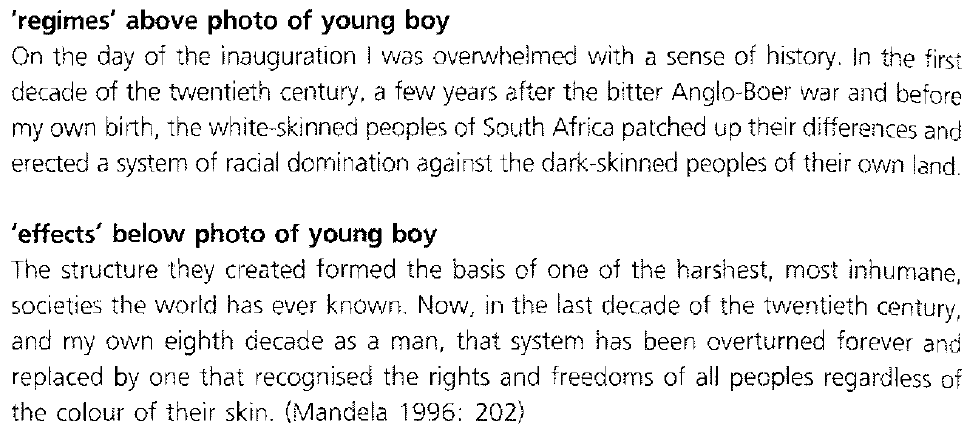
In the horizontal triptych on pages 202-3, the photo of the boy is Given and that of the inauguration is New.  The photos are more salient than the texts by virtue of their colour intensity and Given-New positions, with the inauguration image by far most salient. Our eye is attracted first to this large picture, then back to the photo of the boy, and then to the texts to explain the images for us. Within the left-hand vertical triptych, the image of the boy is more salient than the marginal texts above and below him, due to its size, colour and centrality. As a result we expect these texts to expand on the meaning of the photograph, and indeed they do, with enhancement.


Blogger Comments:

[1] To be clear, Martin & Rose provide no argument here for the applicability of Halliday's information unit to images and page layout. The authors merely accept its use by Kress & van Leeuwen (1996) without question. Moreover, there is no argument for treating the unmarked sequence, Given^New, as the only possible ordering. For information units, the structure may be:
  • Given^New
  • Given^New^Given
  • New^Given
  • New
Here the left image is claimed to be Given information merely because it is positioned to the left of the other image, which is claimed to be (the focus of) New information merely because it is positioned to the right of the other image. Martin & Rose provide no argument as to why a photograph of a boy in the crowd (who is not mentioned in the text) should be Given information relative to the photograph of the flag in the same crowd. It might be argued that the new South African flag is presented as New, but Martin & Rose do not make that argument.

[2] To be clear, here Martin & Rose have (unwittingly) switched their attention from the content plane to the expression plane, confusing salience of expression (size, colour, layout position) with salience of content.

[3] This is misleading, because it is untrue. While it is true that the photograph provides an instance of 'the dark-skinned peoples' mentioned in the texts, the texts above and below the photograph say nothing whatsoever about the meaning of the photograph:

See further in the following post. 

Friday, 7 May 2021

Misapplying A Misrepresentation Of Engagement To A Photograph

 Martin & Rose (2007: 326):

As the boy directly faces the viewer, his defiance/celebration engages us directly, but at the same time his oblique gaze averts a potentially confronting challenge to the viewer. The message is not that I’m defying you, but is rather an invitation to join us in the victory over injustice.


Blogger Comments:

[1] This is misleading, because the boy does not directly face the viewer. His face is oriented to the left and down, relative to the viewer, his eyes further to the left, and his body tilts down and faces to the right of the viewer.

[2] To be clear, the authors' claim that the boy is expressing defiance is inconsistent both with the occasion, the inauguration of Mandela as President, and with other photographs of children purported to depict defiance, such as:

[3] To be clear, as previously observed, this is 'engagement' in the sense of Kress & van Leeuwen (1996), but misrepresented by Martin & Rose as 'engagement' in the appraisal sense.

Tuesday, 30 March 2021

Positive Discourse Analysis

Martin & Rose (2007: 315, 333n):
Research which concentrates on describing coding orientations is of course complementary to action research projects which aim to redistribute access to meaning. You can’t redistribute what you don’t understand, and intervention is what motivates a research interest in language and ideology in the first place. Where CDA has tended to concentrate on the analysis of discourse which sustains inequalities, SFL is equally concerned with redressing inequality. And we think this means looking at the texts through which people make the world a better place alongside those which naturalise power relations we don’t acceptIt’s partly for this reason that we were drawn to the writing of leaders such as Tutu and Mandela who enact reconciliation — who make peace not war. One way of putting this would be to argue that we need to balance critique with Positive Discourse Analysis (or ‘PDA’), so that our interventions have good news to learn from as well as bad news to overthrow (Martin 2002, 2003, 2004a, b, 2006; Martin and Stenglin 2006).


Blogger Comments:

[1] This is misleading, because it is manifestly untrue. On the one hand, a text on Quantum Mechanics can be redistributed by people whether they understand it or not. On the other hand, as this blog demonstrates, Martin & Rose have shown that they can "redistribute" SFL Theory, despite being unable to understand its fundamental architecture.

[2] This is misleading, because it falsely implies that CDA is not "equally concerned with redressing inequality".

[3] To be clear, consistent with the authors' advice, this blog looks at one text, Working With Discourse, which attempts to "naturalise power relations we do not accept". See, for example:

[4] To be clear, one function of using texts of Tutu and Mandela is that doing so garners the admiration of readers who are naïve to the authors' motives. By bathing in reflected glory, Martin & Rose frame any critique of their theorising as opposing the values espoused by Tutu and Mandela.

[5] To be clear, consistent with the authors' advice, this blog "balances critique with PDA" in as much as its "interventions have good news to learn from" (explications of SFL Theory) "as well as bad news to overthrow" (misunderstandings of SFL Theory).


To free a person from error is to give, 
and not to take away.
— Arthur Schopenhauer

To kill an error is as good a service as, 
and sometimes even better than, 
the establishing of a new truth or fact.
— Charles Darwin

Tuesday, 23 March 2021

Misleading The Reader On Discourse Analysis And 'Meaning Beyond The Clause'

 Martin & Rose (2007: 312):

That being said, of course we want to know things about text types, registers and systems as well. … The main thing we’d like to argue for here is not to mistake a lot of clause analysis for discourse analysis. It doesn’t matter how many clauses we analyse, it’s only once we analyse meaning beyond the clause that we’ll be analysing discourse. And we need to analyse discourse right along the instantiation cline if we want to make sense of the semiotic weather we experience in the ecosocial climate of our times.

Blogger Comments:

[1] To be clear, in SFL Theory, text type and register are the same point of variation on the cline of instantiation, but viewed from different poles of the cline. Martin incongruously models these as both 
  • different points of variation on the cline of instantiation of language, and
  • systems of context, not language, with text type (genre) realised by register.
[2] To be clear, in SFL Theory, it is not possible to analyse texts without a model of the system of which the texts are an instance. Halliday & Matthiessen (2014: 731):
A text is meaningful because it is an actualisation of the potential that constitutes the linguistic system; it is for this reason that the study of discourse (‘text linguistics’) cannot properly be separated from the study of the grammar that lies behind it.
[3] This is misleading, because clause analysis is discourse (text) analysis — at one rank, on the stratum of lexicogrammar. To be clear, the central importance of the clause — and of lexicogrammar, in general — for text analysis is explained by Halliday & Matthiessen (2014: 10, 22):
The clause is the central processing unit in the lexicogrammar – in the specific sense that it is in the clause that meanings of different kinds are mapped into an integrated grammatical structure. … Grammar is the central processing unit of language, the powerhouse where meanings are created …
Moreover, as Halliday (1985: xvi-xvii) explained:
The current preoccupation is with discourse analysis, or 'text linguistics'; and it has sometimes been assumed that this can be carried on without grammar — or even that it is somehow an alternative to grammar.  But this is an illusion.  A discourse analysis that is not based on grammar is not an analysis at all, but simply a running commentary on a text … the exercise remains a private one in which one explanation is as good or as bad as another.
A text is a semantic unit, not a grammatical one.  But meanings are realised through wordings; and without a theory of wordings — that is, a grammar — there is no way of making explicit one's interpretation of the meaning of a text. Thus the present interest in discourse analysis is in fact providing a context within which grammar has a central place.

[4] On the one hand, this is a bare assertion, unsupported by reasoned argument. On the other hand, it is misleading, because it is untrue. In SFL Theory, "meaning beyond the clause" is realised by the lexicogrammatical systems of textual cohesion. Text analysis that merely examines the instances of cohesion fails to account for all the meanings that are realised structurally: interpersonal, experiential, logical and textual.

For Martin & Rose, however, "meaning beyond the clause" specifically refers to Martin's discourse semantic systems, so this bare assertion is actually an attempt to bully the reader into using Martin's systems. But, as demonstrated in great detail here, here, and on this blog, Martin's discourse semantics is largely a confusion of Halliday's semantic system of SPEECH FUNCTION (rebranded as Martin's NEGOTIATION), and Halliday & Hasan's lexicogrammatical systems of COHESION (rebranded as Martin's IDENTIFICATION, IDEATION, and CONNEXION/CONJUNCTION), as well as a rebranding of writing pedagogy (the authors' PERIODICITY) misrepresented as linguistic theory.

[5] To be clear, this seriously misunderstands the cline of instantiation. Discourse can only be analysed at the instance pole of the cline, because discourse analysis is the analysis of instances (texts). Halliday & Matthiessen (2014: 660):
A text is thus a unit of meaning – more accurately, a unit in the flow of meaning that is always taking place at the instance pole of the cline of instantiation.

Moving up the cline is a move away from analysing data to theorising language. 

[6] To be clear, this seriously misunderstands the cline of instantiation. The cline of instantiation of which text ("semiotic weather") is an instance is a scale of perspectives on language. The "ecosocial climate of our times", on the other hand, is not language, but culture (context as system), at the current state of its phylogenesis.

Tuesday, 5 January 2021

Confusing Context With Register (And Mode With Genre)

Martin & Rose (2007: 296-7):
Alongside genre, the main construct used by functional linguists to model context is known as register. In SFL, register analysis is organised by metafunction into field, tenor and mode. The dimension concerned with relationships between interactants is known as tenor; that concerned with their social activity is known as field; and that concerned with the role of language is known as mode. Halliday has characterised these three dimensions of a situation as follows:
Field refers to what is happening, to the nature of the social action that is taking place: what it is that the participants are engaged in, in which language figures as some essential component.

Tenor refers to who is taking part, to the nature of the participants, their statuses and roles: what kinds of role relationship obtain, including permanent and temporary relationships of one kind or another, both the types of speech roles they are taking on in the dialogue and the whole duster of socially significant relationships in which they are involved.

Mode refers to what part language is playing, what it is that the participants are expecting language to do for them in the situation: the symbolic organisation of the text, the status that it has, and its function in the context. (Halliday and Hasan 1985: 12)
As language realises its social contexts, so each dimension of a social context is realised by a particular metafunction of language, as follows:
Taken together the tenor, field and mode of a situation constitute the register of a text. As its register varies, so too do the kinds of meanings we find in a text. Because they vary systematically, we will refer to tenor, field and mode as register variables. This model of language in social context is illustrated in Figure 9.1.

Blogger Comments:

[1] This is very misleading indeed. In SFL Theory, register is not a means of modelling context. Register is a functional variety of language, modelled as a point of sub-potential variation on the cline of instantiation from language system to language instance. 

Context, on the other hand, is the culture modelled as a semiotic system that is realised in language. Field, tenor and mode are the metafunctional dimensions of context, but not of register. Different configurations of field, tenor and mode features (Hasan) are realised by different registers of language.

This misunderstanding occurs in Martin (1992), and proliferates through the subsequent publications of Martin, his one-time students, and the less theoretically competent members of the SFL community.

[2] This is misleading, because, in the case of mode, Martin & Rose have selectively omitted the section of the quote that contradicts their model. Cf Halliday & Hasan (1985: 12):
The MODE of discourse refers to what part language is playing, what it is that the participants are expecting language to do for them in the situation: the symbolic organisation of the text, the status that it has, and its function in the context, including the channel (is it spoken or written or some combination of the two?) and also the rhetorical mode, what is being achieved by the text in terms of such categories as persuasive, expository, didactic, and the like.

That is, in SFL Theory, what Martin & Rose model as the purpose of a genre is modelled as a system of mode, the textual dimension of the culture as semiotic system.

[3] This is misleading, because it is not true. What is true is that SFL Theory maps the metafunctional dimensions of language — ideational, interpersonal and textual — onto the stratum of context as field, tenor and mode, respectively. What is not true is that each metafunctional dimension of context is simply realised by its metafunctional counterpart in language. For example, the cultural field of science is realised by interpersonal propositions as much as it is realised by ideational sequences of figures, and their structural elements are given various textual statuses in terms of theme and information.

[4] This is misleading, because it is not true. Moreover, it is a misunderstanding of Halliday & Hasan (1976: 22):

The linguistic features which are typically associated with a configuration of situational features — field, mode and tenor — constitute a REGISTER.

That is, it is not the contextual features of field, tenor and mode that constitute a register, but the features of language that are typically associated with a configuration of them.

In SFL Theory, the field, tenor and mode (features) of a situation characterise the instance of context (situation) that is realised by an instance of language: (text). Here again, Martin & Rose confuse different planes: context vs language, and different points on the cline of instantiation, in this case: register vs text.

To be clear, in SFL Theory, field, tenor and mode are not register variables; they are the dimensions of the culture, whereas registers are functional sub-potentials of language.

Tuesday, 8 December 2020

Perception Management

Martin & Rose (2007: 254):
Meanwhile we’ll leave the last move for this chapter to Tutu, as he is quoted in the production notes to Forgiveness on DVD, the kind of gracious and memorable A2 move we have come to expect from this man:


Blogger Comments:

To be clear, this invites the reader to associate the authors with the graciousness of Desmond Tutu. Previously, the authors have invited the reader to associate one author, Martin, with Nelson Mandela (p62):
His communion with Mandela, at such a distance in so many respects …
For a reality check, see 

Friday, 4 December 2020

Misrepresenting Halliday's Semantic System Of Speech Function As Martin's Discourse Semantic System

Martin & Rose (2007: 251, 252):
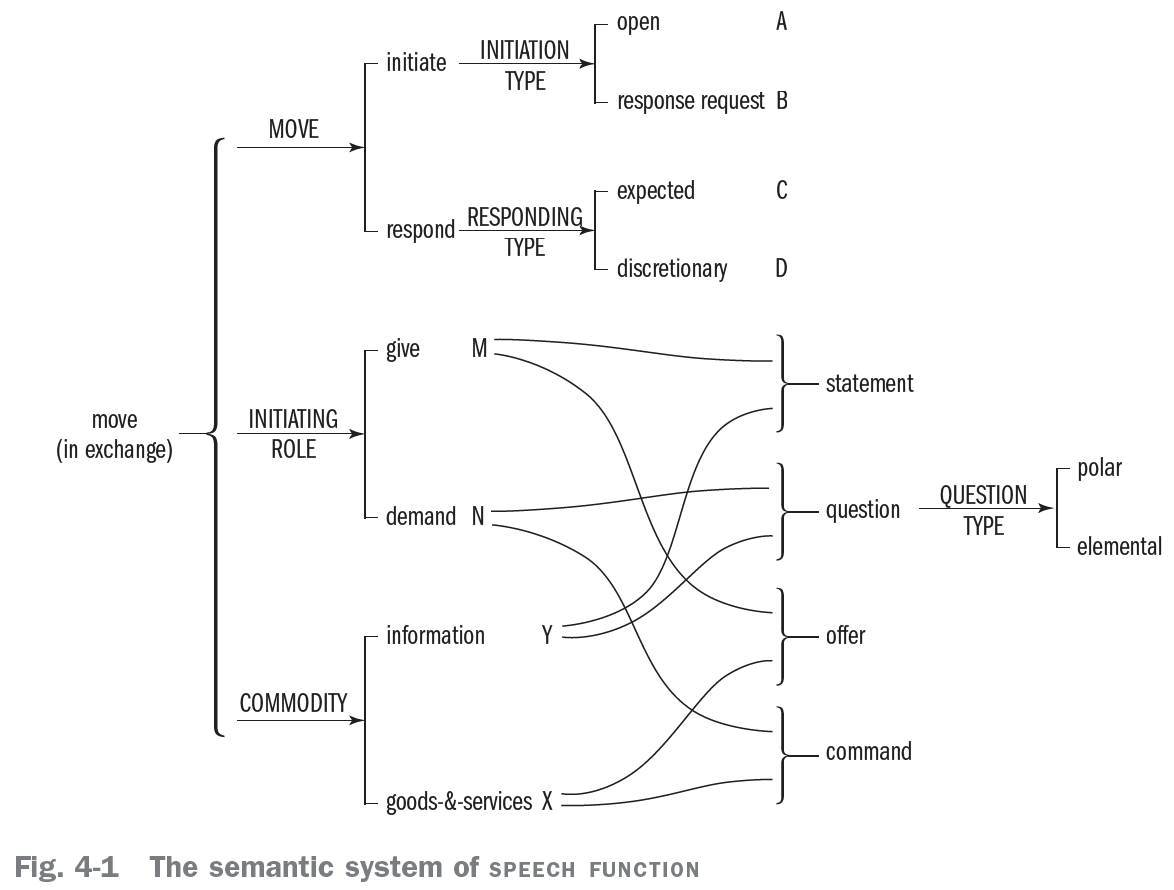
As far as the realisation of SPEECH FUNCTION in MOOD is concerned, we noted the important role played by indirect speech acts (Halliday’s mood metaphors) as far as expanding the meaning potential available for speakers to negotiate within dialogue. The major MOOD options for the English clause are outlined in Figure 7.5. Technically speaking, speech function is a discourse semantic system realised through the grammar of mood (including vocation, tagging, modality and polarity which are not included in Figure 7.5).


Blogger Comments:

[1] Cf Halliday & Matthiessen (2014: 162):


[2] This is misleading, because it misrepresents Halliday's semantic system of speech function as Martin's discourse semantic system. As previously noted, the authors have not acknowledged Halliday as the intellectual source of the system of speech function, anywhere in this chapter.

Tuesday, 1 December 2020

The Authors' System Of Speech Function

Martin & Rose (2007: 251, 252):
In this chapter we’ve developed two systems for analysing dialogue. The first, SPEECH FUNCTION, was designed to explore the relationship between moves and their realisation in grammar (technically speaking their MOOD). The relevant network of choices is consolidated in Figure 7.4, and allows for the 13 basic speech acts presented above. Further delicacy is of course possible; we could for example distinguish questions asking for missing content from those exploring the modality and polarity of a given clause (i.e. Who betrayed Daniel? vs Did one of his friends betray Daniel?). This kind of specificity is much further developed in Eggins and Slade (1997) and in the work of Hasan and her colleagues (e.g. Hasan 1996).

Blogger Comments:

[1] This is misleading, because, once again, the authors' here misrepresent themselves as the intellectual sources of Halliday's system of SPEECH FUNCTION. See, for example, Halliday (1985: 68-71).

[2] To be clear, the network in Figure 7.4

  • has no entry condition, 
  • omits the minor speech function 'alarm' ('warning' vs 'appeal')
  • ungroups minor speech functions ('express self' vs 'attending'), and
  • groups minor speech functions with major speech functions ('attending' with 'negotiating').
Cf Halliday & Matthiessen (2014: 136):

Sunday, 15 November 2020

Misrepresenting Halliday's Approach To 'Calls' As The Authors' Insight

Martin & Rose (2007: 235): 
As a rule of thumb we can include expletives and vocatives in other moves where possible, and treat them as independent moves only when there is nothing to append them to. So Sannie would be a vocative in the following command by her father:
Hendrik: Sannie, go with Father Dalton.
Sannie: - (goes)
But in the movie version of this exchange, Coetzee has been attacked and injured by Ernest, and in the ensuing chaos Hendrik has to first get Sannie’s attention before negotiating his demand for service:
Hendrik: Sannie.
Sannie: - What?
Hendrik: Go with Father Dalton.
Sannie: - (goes)

Blogger Comments:

This is misleading. Yet again, Martin & Rose misrepresent Halliday's theorising as their own. Halliday (1994: 95):

Tuesday, 10 November 2020

Confusing Modal Responsibility With Moral Responsibility

Martin & Rose (2007: 234-5):
Technically speaking, what we are saying is that a move is a ranking clause, including any clauses embedded in it, and in addition any clauses dependent on it. So we can tag the main clauses in the examples below; they are negotiable. Coetzee makes others responsible for the torture facility, not his role in it:
And Sannie makes the village gossipmongers responsible, not her family:
The underlined clauses are not directly negotiable; to make them so would require an additional initiating move in which they are promoted from a subordinate to an arguable position.


Blogger Comments:

[1] This is misleading. Once again, Martin & Rose are misrepresenting Halliday's model of speech function as their own theoretical creation.

[2] To be clear, this confuses moral responsibility (for the torture facility) with modal responsibility (whether or not it is valid to state they had a facility outside Capetown…). 

[3] To be clear, the modal responsibility here is for the validity of the claim they'll say we're selling the house.

[4] To be clear, the projected clause we're selling the house can be challenged in a response move, as exemplified by But we're not (selling the house). Moreover, not only is this possible, it is more likely than a challenge to the projecting clause: But they won't say that.

In short, on the authors' model, the move But we're not (selling the house) would not be analysed as a responding move to they'll say we're selling the house, but would instead be analysed as a new initiating move.

Friday, 6 November 2020

Misrepresenting Halliday's Speech Function As The Authors' Creation

Martin & Rose (2007: 227):
In the previous section we proposed an inventory of 13 basic speech acts; we now need to think about how to distinguish them from one another when analysing conversation. One useful set of markers includes please, kindly, ta, thanks, thankyou, OK, alright, no worries, you're welcome, not a problem, which normally indicate moves concerning goods-and-services. Here Ernest pleads with Coetzee to stay and talk to his parents (until the comrades can get there to kill him):
And Hendrick orders wine for dinner with Coetzee and his family:
Where such markers are not present, we can check to see if they could have been (adding for example please to Hendrik’s command and alright to verbalise Sannie’s response to her father below):

Blogger Comments:

[1] This is misleading. Once again Martin & Rose are misrepresenting Halliday's major and minor speech functions (minus 'alarms') as their own creation.

[2] To be clear, the SFL way to identify speech functions in a text is to take the view 'from above' (the meaning being realised). This means using the semantic system of which they are instances. For example, in the case of major speech functions (realised by major clauses):
  • if information is given, then it is a statement;
  • if information is demanded, then it is a question;
  • if goods-&-services are given, then it is an offer;
  • if goods-&-services are demanded, then it is a command.

[3] To be clear, contrary to SFL Theory, here Martin & Rose advocate taking the view 'from below' (how meaning is realised) instead of the view 'from above' (the meaning being realised).

Tuesday, 3 November 2020

Misunderstanding Halliday's Moodtags And Misrepresenting Them As The Authors' Work

Martin & Rose (2007: 226):
Moves may also end with tag 'questions' (don’t you?, isn't he?, etc.) oriented to the addressee. These tags do not function as separate moves, but are better treated as explicit invitations to a listener to respond. Both of Sannie’s speech acts below would thus be treated as tagged statements (not as statements followed by questions). There is after all only one proposition being negotiated, not two:


 Blogger Comments:

[1] This is misleading. Yet again, Martin & Rose here present Halliday's work as if it were their own. Importantly, the tag doesn't just invite a response; it signals the type of response expected. Halliday (1985:69):


[2] This is misleading. While the first instance is a tagged declarative clause realising a statement, the second instance does not feature a Moodtag, and realises two speech functions, not one. To explain:

Firstly, a Moodtag reprises the Finite and Subject of a clause, so the (unmarked) Moodtag for you could have killed the man is couldn't you? not you know.

Secondly, there are two propositions
  • the projected statementyou could have killed the man, and
  • the projecting question: you know (realised metaphorically as a declarative clause),
each of which could be challenged in response.

Moreover, the projecting clause you know can itself be tagged by don't you?, further demonstrating that it is not a Moodtag but a proposition in its own right.

Sunday, 1 November 2020

Vocatives

Martin & Rose (2007: 225-6):
Moves may contain names which specify who is expected to respond (vocatives). For analysis purposes we recommend not treating vocatives as distinct moves when they simply accompany a speech act, addressing its receiver. This would mean treating Ernest’s move addressing Coetzee below as a statement including the vocative you white piece of shit, and his father’s move as a command including the vocative Ernest:
So vocatives are only taken as separate speech acts when they function as a move on their own, in greeting or calling sequences, as illustrated above… .


Blogger Comments:

[1] This is misleading, because this is simply the analysis that is consistent with SFL Theory, and yet Martin & Rose present it as their recommendation.

[2] To be clear, unknown to Martin & Rose, this an instance of interpersonal metaphor: a command realised by a declarative clause with Mood ellipsis:


[3] Trivially, these are moves in exchanges, not sequences. Sequences (of figures) are ideational, not interpersonal.

Tuesday, 27 October 2020

Misrepresenting Halliday's Minor Speech Functions As The Authors' Ideas

Martin & Rose (2007: 224, 225):
Minimally, we need five more speech acts to complete the picture. Two are concerned with greeting and leave-taking (the hellos and good-byes framing conversations as people come and go, phone up and sign off). We can refer to these as greeting and response to greeting moves. …
Then there is the question of getting people’s attention once they are there - call and response to call. …
Finally we need to consider outbursts of appraisal, such as Helena’s Dammit! in the interpretation stage of her exemplum. … As explosions of personal affect, exclamations are not really negotiable — so we very seldom need to recognise a responding move.


Blogger Comments:

This is misleading, because here Martin & Rose misrepresent Halliday's minor speech functions as their own theorising. Halliday (1994: 95-6):

As can be seen from the above, Martin & Rose fail to include Halliday's minor speech function 'alarm' and its two sub-types: 'warning' and 'appeal'.

Tuesday, 20 October 2020

Misrepresenting Halliday's Ideas As The Authors' Ideas

Martin & Rose (2007: 223):
Based on the examples introduced above we can extract three basic parameters of negotiation — what it is we are negotiating, whether we are giving or demanding it, and whether a move initiates the exchange or responds. First, there is the question of what we are negotiating — information or goods-and-services. Note, as illustrated below, that when negotiating information we expect a verbal response (or gesture), whereas when negotiating goods-and-services we expect action.
These examples also illustrate a second parameter — the complementarity of initiating and responding moves in dialogue. Compliant responding moves may be quite elliptical, since the content being negotiated is easily recovered from the initiating move; and with goods-and-services transactions, language is in any case an optional accompaniment to behaviour (unless we are promising future action).


Blogger Comments:

Here Martin & Rose continue to present Halliday's ideas as if they were their own. Cf Halliday (1985: 68-9):

Sunday, 18 October 2020

Misrepresenting Halliday's SPEECH FUNCTION As The Authors' Model

Martin & Rose (2007: 222-3):
We’ll begin with our model of kinds of moves, focusing initially on statements, questions, offers and commands and compliant responses to them, as set out in Table 7.1.

Blogger Comments:

This is very misleading indeed. As well as failing to acknowledge Halliday as the intellectual source of the system of SPEECH FUNCTION, Martin & Rose here explicitly misrepresent it as their own model. Cf Halliday (1985: 69):

Sunday, 6 September 2020

Surfing Through Waves Of HyperTheme And HyperNew

Martin & Rose (2007: 195-6):
As a general rule, writing looks forward more often than it looks back. So hyperThemes are more common than hyperNews; there’s more ‘prospect’ than ‘retrospect’. But examples of higher level News are not hard to find. Here are two examples from Mandela’s summary of his life at the end of his autobiography Long Walk to Freedom (we’ll return to this text in Chapter 8). Both examples include a hyperTheme, complementing the consolidating hyperNew (in bold):
But then I slowly saw that not only was I not free, but my brothers and sisters were not free, I saw that it was not just my freedom that was curtailed, but the freedom of everyone who looked like I did.
That is when I joined the African National Congress, and that is when the hunger for my own freedom became the greater hunger for the freedom of my people. It was this desire for the freedom of my people to live their lives with dignity and self-respect that animated my life, that transformed a frightened young man into a bold one, that drove a law-abiding attorney to become a criminal, that turned a family-loving husband into a man without a home, that forced a life-loving man to live like a monk. I am no more virtuous or self-sacrificing than the next man, but I found that I could not even enjoy the poor and limited freedoms I was allowed when I knew my people were not free.
Freedom is indivisible; the chains on any one of my people were the chains on all of them, the chains on all of my people were the chains on me.
When I walked out of prison, that was my mission, to liberate the oppressed and the oppressor both. Some say that has now been achieved. But I know that this is not the case.
The truth is that we are not yet free; we have merely achieved the freedom to be free, the right not to be oppressed. We have not taken the final step of our journey but the first step on a longer and even more difficult road. For to be free is not merely to cast off one's chains, but to live in a way that respects and enhances the freedom of others.
The true test of our devotion to freedom is just beginning.
In general terms, the hyperTheme is paraphrased by the body of the paragraph, which is in turn paraphrased by the hyperNew. But the hyperNew is never an exact paraphrase of the hyperTheme, nor is it simply a summary of the wave’s trough; it takes the text to a new point, which we could only get to by surfing through the waves.


Blogger Comments:

[1] To be clear, if this bare assertion is true, it merely means that writers who conform to these pedagogical principles use topic sentences (hyperThemes) more than paragraph summaries (hyperNews).

[2] To be clear, paragraph summaries (hyperNews) are "hard to find" in spoken language. The reader is invited to falsify this claim.

[3] To be clear, if a topic sentence (hyperTheme) is paraphrased by the body of the paragraph and this is paraphrased the paragraph summary (hyperNew), then there is no meaningful distinction between the three in terms of thematicity or newness. But, in any case, an examination of the two texts demonstrates that the three segments in each case are not paraphrases of each other.

More importantly, this has less to do with textual prominence than textual transitions through logico-semantic relations. For example, on this description, the body of a paragraph elaborates the topic sentence (hyperTheme) through (appositive) exemplification, while the paragraph summary (hyperNew) elaborates the body of the paragraph through (clarifying) summation; see Halliday & Matthiessen (2014: 612-6). 

[4] To be clear, anyone trying to surf through waves has misunderstood the notion of surfing, also.